Most compliance mistakes aren't careless. They're out of date.
A program built correctly in 2019 can be wrong in 2026 without anyone touching it.
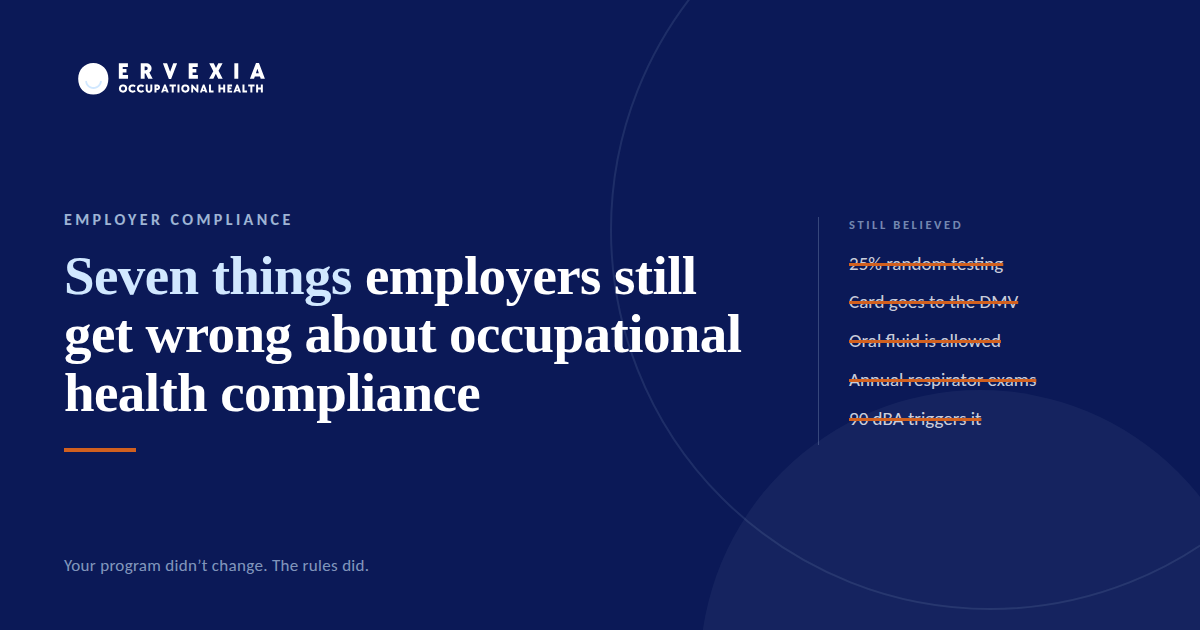
We see the same seven errors constantly- in good companies, with capable safety teams, running programs someone set up carefully years ago. The rules moved. The program didn't.
Here are the seven, with the citation for each, so you can check your own program this week.
(This is general information, not legal advice. Verify against the current regulation and your own counsel before changing policy.)
1. The DOT physical card is not "good for two years."
Twenty-four months is a maximum, not a term. A certified medical examiner can- and often does- issue a certificate for a shorter period whenever something needs monitoring. 49 CFR 391.45(b)
A few shortened intervals are written into the regulation itself: drivers in an exempt intracity zone, drivers certified under the insulin-treated diabetes standard, and drivers certified under the alternative vision standard all require re-examination annually.
Others are discretionary. FMCSA's Medical Advisory Criteria recommend a one-year certificate for Stage 1 hypertension, for example- but those criteria are guidance, not a binding standard, and the examiner retains judgment.
What this means for your fleet: if your driver qualification files are tracked on a flat two-year cycle, some of your drivers are already expired. Track the actual expiration date on each certificate, not the exam date plus 24 months.
2. Your CDL drivers don't take the card to the DMV anymore.
This is the single most out-of-date "fact" still circulating in fleet compliance.
As of June 23, 2025, medical certification for CDL and CLP holders flows electronically- examiner to FMCSA to the state driver licensing agency. Drivers no longer submit the card to the state, and examiners are no longer required to issue the paper Medical Examiner's Certificate to CDL and CLP holders. 49 CFR 391.43(g), 391.45(h)
Non-CDL interstate drivers are unchanged. They still receive the paper certificate and still must carry it. Fleets running mixed CDL and non-CDL drivers get this wrong more than any other group.
One practical caveat: because state posting can lag, FMCSA has issued a rolling series of exemptions allowing a paper certificate to serve as proof of certification for up to 60 days after issuance. The current exemption runs through October 11, 2026. Have drivers keep a copy either way- it costs nothing and it has saved a lot of roadside arguments.
3. FMCSA random drug testing is 50%. Not 25%.
For calendar year 2026, the FMCSA minimum annual random testing rates are 50% for controlled substances and 10% for alcohol. 49 CFR 382.305
The 25% figure you'll find in a great many articles and vendor pages is the FAA rate. FMCSA raised its drug rate from 25% to 50% effective January 1, 2020, and it has not come back down.
These rates are set by federal notice each year and can change, so confirm the current year's figures before you build a testing plan around them.
A related one worth correcting: pre-employment alcohol testing is permitted but not required under Part 382. Pre-employment drug testing is required. Many programs run both because they choose to- that's fine, as long as you know which obligation is yours and which is your policy.
4. You still cannot do DOT oral fluid testing.
The 2023 rule authorizing oral fluid collection in the DOT program is widely reported as though oral fluid is now an option employers can elect.
It isn't- and it never has been in practice. The rule requires two HHS-certified oral fluid laboratories before the method can be used. As of today there are zero. DOT's own guidance says so plainly.
If a vendor is offering you "DOT oral fluid testing," they are not offering a compliant test. Your program remains urine-based until HHS certifies a second laboratory, at which point there is an 18-month transition window.
Related and current: a DOT final rule effective June 10, 2026 amended Part 40 to require directly observed urine collections in the scenarios the 2023 rule had assigned to oral fluid.
5. Respirator medical evaluations are not annual. Fit testing is.
This one costs employers real money in unnecessary exams- and, occasionally, real exposure when it's misunderstood the other direction.
The medical evaluation is required before the employee is fit tested or required to use a respirator. 29 CFR 1910.134(e)(1). After that initial evaluation, OSHA requires additional evaluations only when something triggers one- the employee reports symptoms, a physician or program administrator identifies a need, observations during fit testing suggest a problem, or workplace conditions change in a way that substantially increases the physiological burden. 1910.134(e)(7)
Fit testing is the annual requirement- before first use, whenever the facepiece model or size changes, and at least annually thereafter. 1910.134(f)(2)
Running annual medical evaluations as company policy is perfectly reasonable. Just don't budget for them believing OSHA requires it.
One to watch: OSHA has a proposed rule that would remove medical evaluation requirements for filtering facepiece respirators and loose-fitting PAPRs. It is not final, the rulemaking record was reopened in 2026, and the current requirement is fully in force.
6. Hearing conservation starts at 85 decibels, not 90.
Both numbers are real, and they do different jobs.
- 85 dBA as an 8-hour time-weighted average is the action level. At or above it, you must run a hearing conservation program- monitoring, audiometric testing, hearing protectors made available, training. 29 CFR 1910.95(c)(1)
- 90 dBA is the permissible exposure limit- the exposure ceiling.
Employers who assume nothing is required below 90 are typically missing an entire program.
The testing schedule is specific:
- Baseline audiogram within 6 months of first exposure at or above the action level (within one year if you use a mobile test van, with hearing protectors worn in the interim). 1910.95(g)(5)
- At least 14 hours free of workplace noise before the baseline test.
- An annual audiogram thereafter for every exposed employee. 1910.95(g)(6)
- A standard threshold shift is an average change of 10 dB or more at 2000, 3000 and 4000 Hz from baseline- and the employee must be notified in writing within 21 days. 1910.95(g)(8), (g)(10)
All of it at no cost to the employee.
7. Silica surveillance triggers differently in construction than in general industry.
The two standards are not interchangeable, and using the wrong trigger is a common and consequential error.
- Construction (29 CFR 1926.1153): medical surveillance is triggered for employees required to wear a respirator under the standard for 30 or more days a year.
- General industry and maritime (29 CFR 1910.1053): triggered for employees exposed at or above the action level for 30 or more days a year.
In both, the baseline exam comes within 30 days of initial assignment (unless an equivalent exam was done in the past three years), and periodic exams follow at least every three years.
The exam is specific: work and medical history, a physical with emphasis on the respiratory system, a chest X-ray read by a NIOSH-certified B Reader, spirometry, and testing for latent tuberculosis infection. If your provider isn't doing all five, you don't have a compliant exam.
And the one that catches the most employers of all
The Drug and Alcohol Clearinghouse annual query.
Every driver, at least once a year, requires a limited query. If that limited query comes back showing information exists, you must run a full query within 24 hours- and until it comes back clear, that driver may not perform safety-sensitive functions. 49 CFR 382.701(b)
That 24-hour step is the one we see missed most. It's also the one that puts a prohibited driver behind the wheel.
WHEN DID YOU LAST AUDIT THE PROGRAM ITSELF?
Most employers audit their records. Very few audit their assumptions- the schedule, the triggers, the thresholds the program was built on years ago.
If anything on this list surprised you, that's worth thirty minutes.
Ervexia works with employers nationwide on DOT and non-DOT physicals, drug and alcohol testing, audiometric testing, pulmonary function testing, and respirator fit testing- and we'll tell you plainly where your current program is out of step, whether or not you end up working with us.
Compliance isn't a binder. It's a calendar, and the calendar changed.
This article is general information for employers and is not legal advice, medical advice, or a substitute for the text of the applicable regulation. Requirements change; verify against the current regulation and consult your own counsel before making policy decisions. Federal random testing rates are set annually and the figures cited apply to calendar year 2026.